Thursday, March 21, 2013

Blowing Smoke

We all know the effects that cigarette smoking has on a person; it has been shown for years in the media.  We have seen the yellowing teeth, bad breath, wrinkles, and probably know individuals that have had even more detrimental health issues stemming from the activity.  More and more, smoking is being banned in public places and employers are following suit.  So what does this mean for your practice?

Can I legally not hire smokers?
A number of employers have gone on record announcing that they will not hire smokers.  And, while this sounds as if it the company is promoting a culture of wellness, it can be construed as discrimination.  In fact, there are twenty nine states and the District of Columbia that have protection in place for smokers; below is a list of the states as reported by the American Lung Association. 

■California
■Colorado
■Connecticut
■District of Columbia
■Illinois
■Indiana
■Kentucky
■Louisiana
■Maine
■Minnesota
■Mississippi
■Missouri
■Montana
■Nevada
■New Hampshire
■New Jersey
■New Mexico
■New York
■North Carolina
■North Dakota
■Oklahoma
■Oregon
■Rhode Island
■South Carolina
■South Dakota
■Tennessee
■Virginia
■West Virginia
■Wisconsin
■Wyoming

If you are hiring in these states, it is illegal to base your decision to hire, or not to hire, simply on if the candidate is a smoker. You can, however, choose not to hire a candidate based on other, legal, factors.   Frankly, you may miss out of some great talent by limiting the pool based upon if the candidate smokes as the single factor as the CDC found that 19% of all American adults were smokers in 2010.
What can I do as an employer?
As an employer, it is within your right to ban smoking on your property.  While this will not stop the smokers completely, it will deter the activity on company time and in front of your patients.
It is also worthwhile to look into cessation plans for your employees.  If your dental practice currently offers an EAP (Employee Assistance Program), look into the benefits that it provides and encourage your staff to take advantage of the services. 

Another option to consider is a having cessation program available. The American Lung Association endorses its own program, Freedom From Smoking, as an option for employers to provide to their staff; it allows the employee different options to cater to their own lifestyle such as online support, a hotline, and one on one support.  For more information, check out this site: Freedom From Smoking.
With the right resources and encouragement; you can make a difference in promoting a smoke free workplace while retaining quality staff.  Monitor the results of your efforts and listen to the feedback of the staff members.  It is possible to have a happy, healthy staff.  A happy staff is a productive staff; and that is not just “blowing smoke.” 

Contributed by Tiffany Worstell, Dental Staff Recruiter- Nationwide. To Contact Tiffany, call 540-491-9112, or email at tworstell@etsdental.com

Friday, March 8, 2013

Sequestration's Effect on Professional Employment

When the Bureau of Labor Statistics released its monthly employment report for January, it also released revisions to data for all of 2012, revisions that were remarkably more positive than what had been previously reported. In total, 647,000 more jobs were created in the United States last year than BLS reports had indicated. While that is only about 0.41 percent of total U.S. workforce, it significantly alters the estimate of year-over-year growth. As of January, before the adjustment, total employment year-over-year was up less than 1.2 percent. With the adjustment, average growth in 2012 grew to more than 1.5 percent, in line with the 40 year average, and well above the 20 year average of 1.1 percent annual growth. In fact, in the last 10 years employment has only grown an average of 0.3 percent per year. By these metrics, 2012 was at least an average year for employment growth and in recent history was actually above average.

This year, however, is already presenting new challenges and changing dynamics. The debt crisis in Europe has backed off from the cliff, putting a pin back in one of the largest potential economic grenades on the horizon. Yet, the cost-cutting effects from sequestration appear increasingly unavoidable and will in the coming months have measurable consequences across the military, military support, research, education and other sectors that rely heavily on government support.


While the cuts will have a rapid near-term effect on employment, they may also create a temporary talent acquisition opportunity for employers. Many of the positions affected are filled by highly trained people in disciplines that have continued to experience increasing talent shortages in recent years.

"In layoffs like these, that have nothing to do with job performance but rather fallout from much larger issues, highly qualified and capable people end up entering the job market," says Rob Romaine, president of MRINetwork. "It means a short window of availability for private sector employers to scoop up experienced professionals in disciplines like engineering, IT, accounting, and project management."

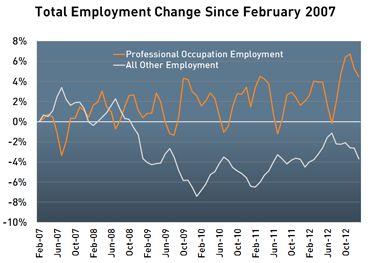
Total employment in the U.S. shrank by more than 6 percent during 2008 and 2009. Yet, despite comprising more than 20 percent of the U.S. workforce, employment of those in professional and related occupations remained essentially flat during those years and has since resumed its pace of growth.

“Historically, government layoffs in sectors like defense have had only a short-term impact on employment because the types of people who are laid off are inherently highly employable,” notes Romaine. “While these cuts will be reaching far beyond defense spending, the principle still applies for many of the industries that will be affected, which points to an opportunity for employers.”

This isn’t to say that sequestration will be a big boon for the U.S. economy. Many economists project sequestration will remove as much as 1.5 percent of GDP from the economy in 2013 and blame it for the sharp decline in GDP growth during the 4th quarter of 2012. Private-sector activity, however, is rebounding, and in the 4th quarter was enough to counter nearly a 15-percent drop in government expenditure and keep total GDP growth virtually flat.

“There was such a shortage of experienced talent before the recession that even with the sharpest economic decline in more than a generation, professional employment levels didn’t decline,” notes Romaine. “While the economy may slow again by the end of the year, we shouldn’t expect that to lower the demand for professional talent nor affect the availability of experienced professionals.”

Wednesday, March 6, 2013

Financial Planning for a Better Future with Glen Weaver


Time and again we speak with dentists whose careers were significantly impacted by financial decisions outside of the practice. Many were impacted for the worse, but those with a clear plan and the guidance of financial planners are significantly better off for having done so. With that in mind, we recently invited Glen Weaver of Capital Financial Partners to contribute. Glen has experience advising dentists and dental practice owners and so has a good perspective on the questions dentists should be asking themselves and their advisors.
Here is his summary of the important questions dentists need to be asking:
 
Every business professional generally thinks about the following:
  • How can I grow and protect my business?
  • How can I take care of and provide a rewarding future for my employees?
  • How can I build wealth and protect my assets so I retire on my terms and leave a legacy for my family?
  • How can I protect my principal from the volatility of the market?
  • What financial strategies can I implement so when the market crashes again I don’t lose any money?
  • How can I get guaranteed tax-free income for life?
  • Did you know that over 450 banks across the US have failed since 2008?  How is that possible?
  • Do you know who the best financial managers in the world are and have proven it through various depression eras over the last century?
  • Do you have a Variable Life product?
If you do not have these answers then you need to speak with someone who does.

Keep in mind, rising inflation and tax rates can quickly erode retirement savings. You will need more money during retirement to purchase the same things you buy today. Tax rates are rising with plans in Washington to raise them even further. Do you have a plan that allows you to pay current tax rates, grow your money tax-deferred, and then enjoy tax-free income for life?

I am frequently asked, “How can I plan for my kid’s college that does not involve poor performing 529's? With higher education tuition rising at nearly 9% every year, how can I get more aid/grants/scholarships from colleges/universities for my kids education simply by moving assessed assets to non-assessed buckets?”

Did you know with the right plan your kids could attend a private school at or better than the price of a state school?

Regardless where you are in your practice and career if you fail to plan, you plan to fail.  One of the greatest motto's for success is: Plan Your Work and Work Your Plan!  You have objectives and goals for the future that fosters the professional, personal and economic growth of your business and staff members, but do you have a defined plan to get there?  Don’t kid yourself. Most people don’t.

Henry Ford had an 8th grade education. He also had an incredible belief that an 8 cylinder car was possible. He surrounded himself with a team of engineers, advisors, and together went to work on their plan. As we all know and see everyday on the roads, Ford created enormous wealth and legacy for generations.

Consider adding a financial planner to your team. We have the skill, experience, and resources to weather any market situation to keep you on the path of financial growth and prosperity for generations to come. With good people, like Morgan Pace at ETS Dental, we can plan a very rewarding future together. A simple no obligation phone call, email, or connection on Linkedin is all it takes to continue the journey.

For more information, contact:

Glen Weaver
Financial Services/College Planning Advisor
Capitol Financial Partners
703-222-1960
weagl01@gmail.com
http://www.linkedin.com/profile/view?id=22383898&trk=tab_pro

Wednesday, February 20, 2013

How Much Do Associate Dentists Make?


Just as there is more to life than money, there is more to a job than income. Like it or not, though, income is one of the primary motivators for job seekers. So what is realistic for an associate to make?

As recruiting consultants, we have interviewed thousands of dentists- more than 1,800 in 2012 alone. Using the information gathered from those interviews we were able to identify some general trends and averages for dentists who are either active job seekers or who are keeping an ear open for better opportunities. This is not a scientific analysis by any means. Results including self-reported income levels are inherently suspect, but we have done our best to take into account actual income based on reported production in addition to the responses of applicants.

In order to make the information more meaningful, I grouped our responses into three categories. "Early Career Dentists" includes doctors with less than five years of experience. "Mid-Career Dentists" have between five and fifteen years of experience. "Established Dentists" have more than fifteen years of experience and generally represent dentists who have either owned a practice and returned to the workforce, or who have opted for a career outside of ownership.

Average Associate Dentist income across all experience levels: $149,000 annually
Average Early Career Associate Dentist income: $135,000 annually
Average Mid-Career Associate Dentist income: $154,000 annually
Average Established Associate Dentist income: $163,000 annually

There are many factors that affect income. Practice type, location, patient load, and associate experience are all very important. Dental Economics and the Levin Group collaborate to put out an annual survey that includes a break down of the difference in income between different community types. You will see that the highest income potential is often not in the major cities but in the secondary markets, where there is less competition for patients, but where the local economy and population are sufficiently diverse to support a thriving private practice.

Note: The first number is the median and the second is the mean.


You can download the full survey results along with analysis at the Levin Group website: http://www.levingroup.com/gp/index.php/2011-10-25-17-53-19/delg-survey

For additional information on local income trends, contact the ETS Dental Recruiting consultant specializing in your area. A list of our recruiting consultants and their areas of focus can be found here: http://www.etsdental.com/about/team.htm.

Contributed by Morgan Pace, Senior Dentist Recruiter for ETS Dental,www.etsdental.com | mpace@etsdental.com | 540-591-9102

Friday, February 15, 2013

The Independent Contractor Status Draws Scrutiny in Dental Practices

This great article was written and shared by Dental CPAs. Check them out at their website:
 
The government does not hold any grudges against independent contractors. Employers who attempt to avoid paying employment taxes by falsely classifying employees as independent contractors are another story. The government doesn’t like anyone who evades paying taxes.

Independent contractors are valid in various industries given the proper circumstances, including dentistry. However, the government has and will continue to look for abuses of the classification where employers attempt to evade employment taxes.

People who wish to be considered independent contractors (IC) should arrange their circumstances so that their case as an IC is defensible. Some of these circumstances may include: being able to perform work duties freely in the facilities of the owner, getting paid by the project or service (not hourly), paying for their own materials or supplies, using their own equipment, hiring and paying their own staff and control the result of their product or service. If these circumstances are not in place with the owner of the business, the general IC may not be an IC at all, they may be an employee.

One of our client’s is a dental specialist. They don’t own their own practice, they work in offices of other practitioners. They bring their own staff, they control their work process and the outcomes, their services are billed separately, they decide the days they work and because they’re a specialist, the owner can’t supervise their work (tell them how to do it). They also operate from their own entity so the contract is between two entities, an individual is not involved, other than the person providing the service.

Businesses must weigh the degree of the behavioral and financial relationships with workers when classifying them.

The consequences for the owner who misclassifies an employee as an independent contractor could be: A. they’re assessed the employer’s portion of the social security and Medicare tax, B. federal unemployment tax, and, if the owner cannot prove the independent contractor reported the income on their return, they may also assess the employee’s portion of social security and Medicare tax, plus penalties and interest. If the owner had any employee benefit plans that should have covered the IC (health and retirement plans), there could be negative consequences there as well.

If you are an independent contractor, you are self-employed. To find out what your tax obligations are, visit the Self-Employed Tax Center on the IRS website.

You are not an independent contractor if you perform services that can be controlled by the owner (what will be done and how it will be done), you use the owner’s equipment and supplies, you service the owner’s patients or clients and they tell you when to work. This applies even if you are given freedom of action. What matters is that the owner has the right to control the details of how the services are performed. For example, a general dentist is working for another general dentist as an associate, the associate uses the dental staff, they are being supervised by the owner, they are told the hours they are working, they use the owner’s equipment and supplies, and this is the only office they work for. This associate would likely be classified as an employee.

If an employer-employee relationship exists (regardless of what the relationship is called), you are not an independent contractor.

This is a serious issue for owners who are either intentionally or unintentionally misrepresenting relationships with workers. In cases of abuses, the owner is the party that will likely take the beating.
I recall back in the late 80's when I had a stock broker tax client where all the brokers of this small firm were being treated as independent contractors. The IRS audited the brokerage for several years for the very issue being discussed. The brokers had to submit returns to prove that they were reporting their income correctly and paying the Self-Employment tax while the brokerage firm got slammed for hundreds of thousands of back payroll taxes, penalties, and interest. Ultimately, the brokerage went belly up, many people became unemployed and many clients had to find new brokers or move their money to the brokerage where their broker landed.

We've had similar stories on a much smaller scale where IRS reclassified independent contractors as employees and made the client pay back payroll taxes, interest, and penalties. I have only heard of one case where the independent contractor themselves got audited and reclassified as an employee and they got hammered income tax wise because schedule C expenses became miscellaneous itemized deductions subject to limits and their self-employed retirement plan deduction got thrown out.

The bottom line is in just about every audit of a business, one issue the agent must take a look at is the employee vs. independent contractor issue to ensure employers aren't trying to evade employment taxes.


Thanks again for allowing us to share your article, Dental CPAs!