Wednesday, April 24, 2013

Potential Hiring Red Flags for Dental Practices

We interview thousands of dentists and dental office staff applicants each year, and we look through at least three times as many resumes.  Many have glaring red flags and some are so subtle that asking more questions or investigating is required.

Here is a list of job candidate red flags.  
  • Didn't submit a current resume. 
  • Will only discuss duties and responsibilities, not achievements. 
  • Does not provide relevant references upon request. 
  • Will not provide salary information. 
  • Has unrealistic salary expectations. 
  • Will not sign a consent to release background information. 
  • Is unrealistic about expectations for the next opportunity. 
  • Will not call back at designated times. 
  • ‘Disappears’ for a period of time. 
  • Is currently unemployed. 
  • Has been unemployed for long periods. 
  • Has made rapid job changes. 
  • Changes not just from job to job, but title to title, or industry to industry. 
  • Gives no specifics on reasons for leaving. 
  • Suddenly wants to move far from an area that has been home for many years
  • Has a consistent reason for leaving – has a ‘pattern.’ 
  • Appears to make poor/illogical career moves. 
  • Has weak references. 
  • Has low educational qualifications as compared to the norm. 
  • Will only provide dates of employment in years. 
  • Becomes angry when asked a specific, legitimate question. 
  • Changes tone/presentation during the interview. 
  • Is hesitant to respond to your questions. 
  • Does not respond consistently to interview questions. 
  • Has no idea of his or her next career step. 
  • Suddenly brings up family/personal issues that would prevent accepting an offer. 
  • Resume shows no progressive growth or mobility. 
  • You feel you have to be ‘nice’ to candidate to get a response or to receive paperwork.
  • Once offer is made, keeps trying to negotiate more and more changes.
Let us know if you have any to add or comments.

Carl Guthrie is a Dental Recruiter with ETS Dental. He covers the Western U.S. Region. Carl can be reached at cguthrie@etsdental.com.

Wednesday, April 10, 2013

Personality-Focused Interviewing

Have you made the decision that it's time to hire a new associate? While skills and experience are important as you plan for a new employee, the right chemistry or personality can make or break your team. Before starting the interviews, it's important to define the atmosphere of your practice and look for personalities that will fit in easily and enhance that atmosphere.

Go in to the interview with the goal of discovering a true sense of the potential new associate's personality by allowing your own personality to be seen. Make the interview more of a conversation rather than an interrogation. "You put people on guard if you ask them to reveal something about themselves but don't give them anything in return," says Jonathan Basker, a vice president at Betaworks, a New York-based company that builds social web companies. He recommends acting natural and opening up to interviewees about yourself and your practice. As the conversation flows, encourage questions about yourself or your practice from the potential hire.

Have a good idea of what personality type your practice needs to run smoothly. Are you looking for someone serious or fun-loving? Are you open to different cultures? "To find the right people for your company, your hiring process needs to give each candidate an opportunity to showcase their personality. Creating that level of comfort is a matter of knowing what you want and establishing trust," says Nadia Goodman, contributor to Entrepreneur.com(http://www.entrepreneur.com/article/225852#ixzz2PvdwHBj3).

Your goal is to find a match, so the right person will be comfortable with the challenges they'll face and excited about the opportunities. "Let them know it's okay if you're not looking for the same thing," Basker says. "That permission lets them show a real version of themselves."

Contributed by Marsha Hatfield-Elwell, Dental Recruiter for DE, D.C., FL, MD, NJ, and PA. To Contact Marsha, call 540-491-9116, or email at melwell@etsdental.com.

Friday, April 5, 2013

Managing Return on Human Capital

When a factory is providing its maximum return on capital it is easy to see. A third shift needs to be added, the loading dock is constantly nearing capacity with product before the trucks come to take it away, and inputs are arriving just in time to be put into production.

Return on human capital, though, requires a different perspective and analysis because of how malleable that capital is. A hydroforming aluminum press that is set up to manufacture parts of a monocoque automotive chassis cannot put out a different product without significant retooling that could take days. Humans are quite different. A senior in-house legal counsel can just open a different document and suddenly be doing the work of a paralegal--yet at several times the hourly cost. If this scenario were occurring regularly across sales, marketing, development, and operations roles, everyone at the managerial level would appear to be busy, working at capacity, yet the company would be operating well below the potential return on capital.

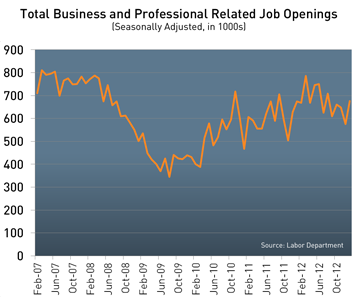
"During the recession, asking people to absorb other roles and make do with lower staffing levels helped to trim budgets and survive in lean times," says Rob Romaine, president of MRINetwork. "Nearly three years after the end of the recession, though, employers are hiring throughout their organizations, and there are nearly 3.7 million current job openings."

The highest job opening rate is in the professional and business sector where there is one job opening for every 27 workers currently employed, in contrast to one opening for every 33 healthcare workers or one for every 50 construction workers. Considering that the unemployment rate for management, professional and related occupation professionals is 3.8 percent, or one in 26, the sector is essentially near full employment.

"Maximizing your return on investment when it comes to professional talent today isn't a matter of how lean you can run the organization, but rather how effectively you are utilizing your top talent," notes Romaine. “This has been one of the largest shifts in talent demand this year. Managers aren't just looking at the capabilities they can add to their organization, but how to add talent that will let their talent reach their highest potential,” says Romaine.

While in a simple way this might mean freeing top producers of the responsibilities that distract from them doing what they do best, Romaine says it can also involve a more nuanced approach.

"A lone wolf could do amazing things, yet appear to be peaking in their performance. By bringing in someone on a similar level but with a different background, a manager can help to spark the rigorous debate and examination that allows a once plateaued performer to continue to grow and do their best work," says Romaine.

When talking about an organization's top performers, though, the conversation inevitably has to return to not just how to develop them, but how to retain them. A recent survey by the American Management Association showed that more than a third of employers are expecting turnover to increase in the coming year, while less than 20 percent of those employers feel they are well prepared for that turnover.

“Top talent is driven by success, their ability to have a positive impact on their organization, and the potential to continue to grow," says Romaine. "Building out teams that help top talent to grow is vital to increasing job satisfaction at a time when finding experienced replacements is becoming increasingly difficult. But helping your best people to work better also directly improves your return on human capital.”

Thursday, March 21, 2013

Blowing Smoke

We all know the effects that cigarette smoking has on a person; it has been shown for years in the media.  We have seen the yellowing teeth, bad breath, wrinkles, and probably know individuals that have had even more detrimental health issues stemming from the activity.  More and more, smoking is being banned in public places and employers are following suit.  So what does this mean for your practice?

Can I legally not hire smokers?
A number of employers have gone on record announcing that they will not hire smokers.  And, while this sounds as if it the company is promoting a culture of wellness, it can be construed as discrimination.  In fact, there are twenty nine states and the District of Columbia that have protection in place for smokers; below is a list of the states as reported by the American Lung Association. 

■California
■Colorado
■Connecticut
■District of Columbia
■Illinois
■Indiana
■Kentucky
■Louisiana
■Maine
■Minnesota
■Mississippi
■Missouri
■Montana
■Nevada
■New Hampshire
■New Jersey
■New Mexico
■New York
■North Carolina
■North Dakota
■Oklahoma
■Oregon
■Rhode Island
■South Carolina
■South Dakota
■Tennessee
■Virginia
■West Virginia
■Wisconsin
■Wyoming

If you are hiring in these states, it is illegal to base your decision to hire, or not to hire, simply on if the candidate is a smoker. You can, however, choose not to hire a candidate based on other, legal, factors.   Frankly, you may miss out of some great talent by limiting the pool based upon if the candidate smokes as the single factor as the CDC found that 19% of all American adults were smokers in 2010.
What can I do as an employer?
As an employer, it is within your right to ban smoking on your property.  While this will not stop the smokers completely, it will deter the activity on company time and in front of your patients.
It is also worthwhile to look into cessation plans for your employees.  If your dental practice currently offers an EAP (Employee Assistance Program), look into the benefits that it provides and encourage your staff to take advantage of the services. 

Another option to consider is a having cessation program available. The American Lung Association endorses its own program, Freedom From Smoking, as an option for employers to provide to their staff; it allows the employee different options to cater to their own lifestyle such as online support, a hotline, and one on one support.  For more information, check out this site: Freedom From Smoking.
With the right resources and encouragement; you can make a difference in promoting a smoke free workplace while retaining quality staff.  Monitor the results of your efforts and listen to the feedback of the staff members.  It is possible to have a happy, healthy staff.  A happy staff is a productive staff; and that is not just “blowing smoke.” 

Contributed by Tiffany Worstell, Dental Staff Recruiter- Nationwide. To Contact Tiffany, call 540-491-9112, or email at tworstell@etsdental.com

Friday, March 8, 2013

Sequestration's Effect on Professional Employment

When the Bureau of Labor Statistics released its monthly employment report for January, it also released revisions to data for all of 2012, revisions that were remarkably more positive than what had been previously reported. In total, 647,000 more jobs were created in the United States last year than BLS reports had indicated. While that is only about 0.41 percent of total U.S. workforce, it significantly alters the estimate of year-over-year growth. As of January, before the adjustment, total employment year-over-year was up less than 1.2 percent. With the adjustment, average growth in 2012 grew to more than 1.5 percent, in line with the 40 year average, and well above the 20 year average of 1.1 percent annual growth. In fact, in the last 10 years employment has only grown an average of 0.3 percent per year. By these metrics, 2012 was at least an average year for employment growth and in recent history was actually above average.

This year, however, is already presenting new challenges and changing dynamics. The debt crisis in Europe has backed off from the cliff, putting a pin back in one of the largest potential economic grenades on the horizon. Yet, the cost-cutting effects from sequestration appear increasingly unavoidable and will in the coming months have measurable consequences across the military, military support, research, education and other sectors that rely heavily on government support.


While the cuts will have a rapid near-term effect on employment, they may also create a temporary talent acquisition opportunity for employers. Many of the positions affected are filled by highly trained people in disciplines that have continued to experience increasing talent shortages in recent years.

"In layoffs like these, that have nothing to do with job performance but rather fallout from much larger issues, highly qualified and capable people end up entering the job market," says Rob Romaine, president of MRINetwork. "It means a short window of availability for private sector employers to scoop up experienced professionals in disciplines like engineering, IT, accounting, and project management."

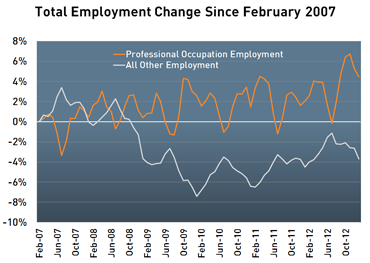
Total employment in the U.S. shrank by more than 6 percent during 2008 and 2009. Yet, despite comprising more than 20 percent of the U.S. workforce, employment of those in professional and related occupations remained essentially flat during those years and has since resumed its pace of growth.

“Historically, government layoffs in sectors like defense have had only a short-term impact on employment because the types of people who are laid off are inherently highly employable,” notes Romaine. “While these cuts will be reaching far beyond defense spending, the principle still applies for many of the industries that will be affected, which points to an opportunity for employers.”

This isn’t to say that sequestration will be a big boon for the U.S. economy. Many economists project sequestration will remove as much as 1.5 percent of GDP from the economy in 2013 and blame it for the sharp decline in GDP growth during the 4th quarter of 2012. Private-sector activity, however, is rebounding, and in the 4th quarter was enough to counter nearly a 15-percent drop in government expenditure and keep total GDP growth virtually flat.

“There was such a shortage of experienced talent before the recession that even with the sharpest economic decline in more than a generation, professional employment levels didn’t decline,” notes Romaine. “While the economy may slow again by the end of the year, we shouldn’t expect that to lower the demand for professional talent nor affect the availability of experienced professionals.”